History & curiosities
The valley holds a few surprises for anyone who scratches at its history: a pope, an inventor, chapels, and an extraordinary bell.
A pope born in the valley
Peter of Tarentaise, a Dominican renowned for his learning, was elected pope in 1276 as Innocent V — the first pope from the Dominican order. His pontificate was brief: he died that same year, after only five months.
Savoyard tradition holds him a native of the Tarentaise, and Champagny proudly claims that cradle. Michel celebrates it in his « Ode à Champagny », without boasting:
Si d'un Pape illustre, tu fus le berceau, Rien chez toi n'indique la vantardise, Simplement, tu conserves le souvenir toujours haut De son passage dans notre vieille église.
The rice pioneer
Another child of the valley: Clair Ruffier des Aimes, born in Champagny-le-Haut into a large farming family. Having gone to work in the lowlands — pasta, then semolina — he set up on his own as a semolina maker before 1900, supplying the pasta factories of Savoie and Lyon.
He added the import of raw rice, which he processed and resold across France. After 1918 he sought irrigable land and achieved the first successful rice-growing trials in the Camargue — so much so, it is said, that France did not run short of rice during the years 1940-1944.
A co-founder of the Marseille Rice Exchange, he was made a Chevalier of the Légion d'honneur in 1925. He died in Marseille in 1946.
Churches and chapels
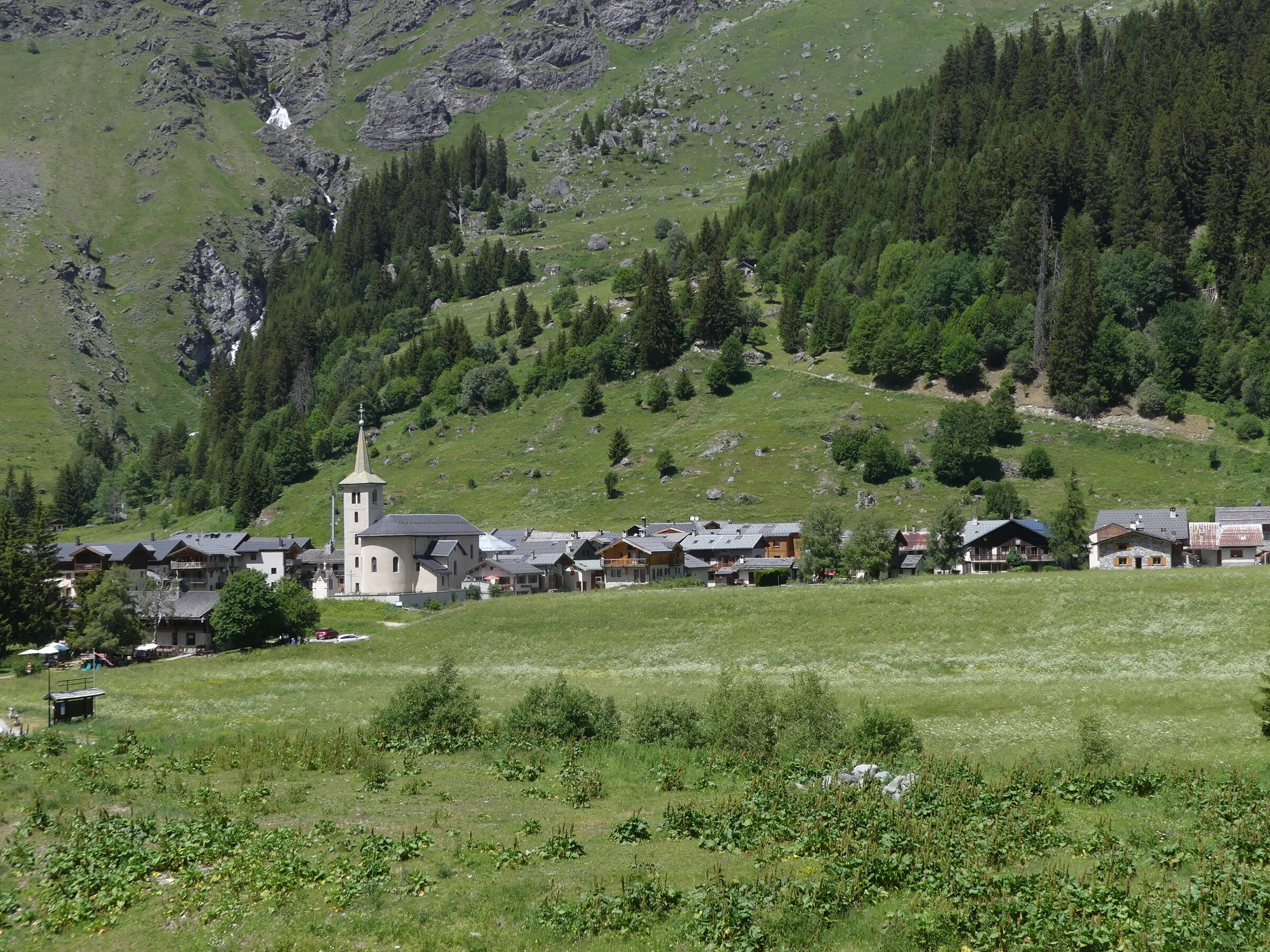
Each hamlet has its chapel: Sainte-Trinité at La Chiserette, Saint-Clair at Le Bois, Notre-Dame-des-Grâces at Friburge, Notre-Dame-des-Neiges at Laisonnay. The parish church of Saint-Clair, at Le Bois, was rebuilt in 1888 thanks to the inhabitants' gifts; the old church, beside the dairy, was then sold, and the dead moved to the new cemetery.
Higher up, in the pastures, the little chapel of La Plagne already existed before 1730: it is the first you meet arriving over the Col du Palais. Two men lie beside it — perhaps two Italian smugglers, swept away by a spring avalanche, and never found.
La Savoyarde
Michel also recorded, with pride, a Savoyard glory: the largest bell in France. Given by the dioceses of Savoie to the Sacré-Cœur basilica in Montmartre, it was nicknamed “la Savoyarde”.
Cast in 1891 by the renowned Paccard foundry, in Annecy-le-Vieux, it weighs nearly nineteen tonnes (18,835 kg) — its clapper alone 850 kilos. It was some years before it reached Paris and finally rang out over the Montmartre hill.
From farm to ski resort
For a long time, Champagny lived only from farming. The turn came gently: the first visitors were the spa-goers of Brides-les-Bains, from 1820, then a few summer guests at the Hôtel des Gorges, in Le Bois — where General Chambe came to shoot black grouse.
The great shift was skiing. In January 1971, a chairlift linked Champagny to the La Plagne area; in 1986, the gondola took over. The village, whose population had fallen to 370 in 1975, began to come back to life — the young working in winter at the resort, in summer on the mountain.
It is this story — from farm to ski resort — that our chalets carry on today: former barns and family houses turned into places of welcome.